
Engineering practice
Software Engineering: From Bit-Exact to LLM Probability
What an engineer trained to make every output deterministic learns when software starts answering in distributions.
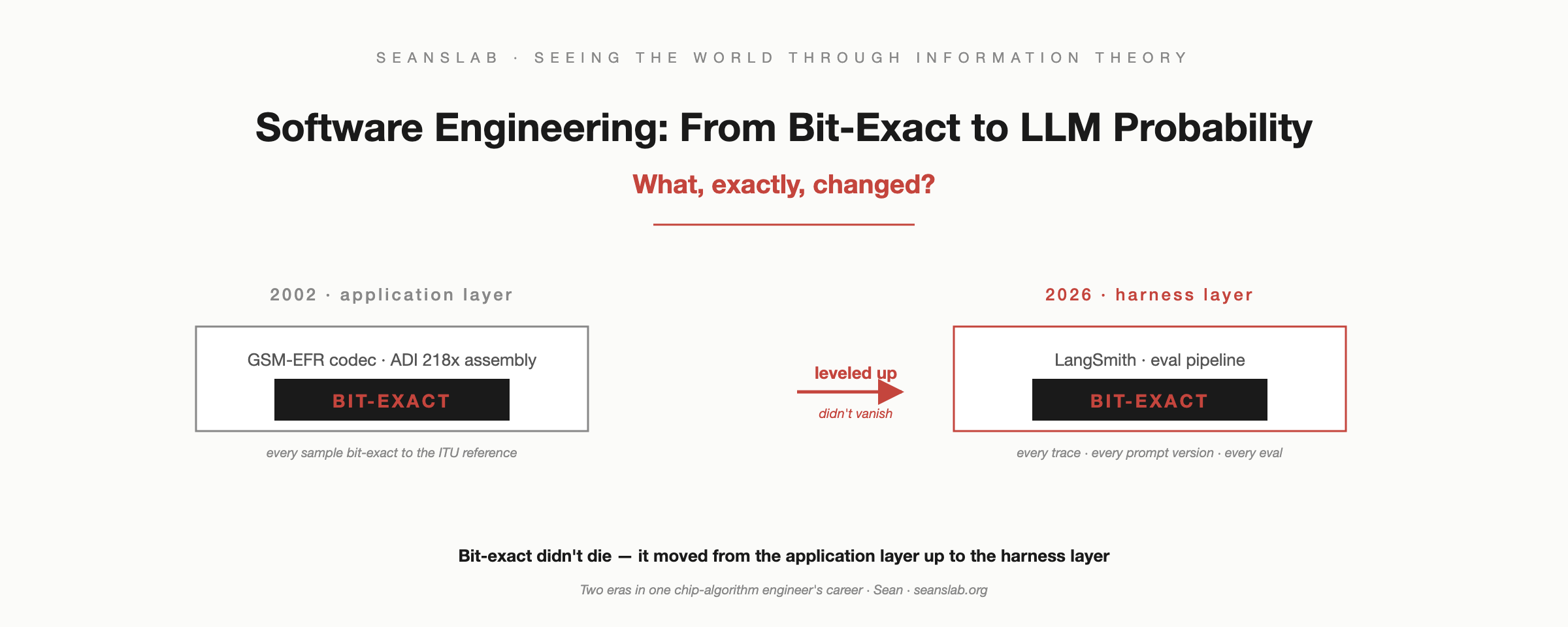
Two eras in one chip-algorithm engineer’s career — and why losing absolute determinism is a homecoming, not a loss.
2002 · Chasing bit-exact, one line of assembly at a time
I was still a master’s student that year, working on a project at a small company called Coast Communications.
The task was blunt: reimplement the GSM-EFR speech codec in ADI 218x fixed-point DSP assembly — the codec ETSI had standardized in the late 1990s and that was being rolled out, at scale, into 3G phone basebands.
The ITU gave you two things: a reference codec written in C, and a set of test vectors (input speech + reference output bitstream). My job was simple and brutal: rewrite that C into ADI 218x assembly, get it running, and compare the output bit-by-bit against the reference.
Not 95%. Not 99.99%. Every single bit identical — thousands of test vectors, hundreds of frames each, hundreds of bits a frame. One wrong bit anywhere, and the whole project failed.
That was the highest aspiration of an engineer in that era: absolute determinism.
But GSM-EFR isn’t ordinary software. It’s built on ACELP (Algebraic Code-Excited Linear Prediction), with dozens of inner loops, each doing hundreds of multiply-accumulates. Any single accumulator saturating slightly differently, or one basic operator rounding differently from the ITU reference, and the error starts to compound.
The next three to four months split into two phases.
Phase one was translating the ITU C reference into ADI 218x assembly, compiling it, and getting basic functional tests to pass — confirming the output was roughly speech and not noise, that the quantizers and filters worked, that the bitstream structure was right. That part was relatively clean; the codec ran end-to-end within a few weeks.
Phase two is the one that grinds you down — taking “roughly correct” to bit-exact. The loop went like this:
- Run the whole ITU test-vector set, find the first one that fails.
- Dump every frame’s intermediate state in my implementation — LPC coefficients, excitation signal, quantizer indices, the internal accumulators.
- Compare against the reference’s intermediate state, find the first frame that deviates.
- Inside that frame, dump every iteration of every inner loop.
- Find the first loop iteration that deviates.
- Inspect that specific multiply-accumulate — was the saturation wrong? Round-to-even instead of round-to-nearest? Did one basic operator (L_mac, mult_r…) in my assembly differ from the ITU C by 1 LSB at a boundary?
- Fix it. Re-run the whole set.
Behind every bit of deviation was a corner case of some ITU basic operator — a particular saturation behavior, a 40-bit accumulator that happened to overflow on one iteration of one frame where the reference didn’t.
Three to four months later, every test vector passed bit-exact.
In that moment I believed software could achieve absolute determinism — that if you were willing to spend the time, every bit could be predicted, verified, guaranteed.
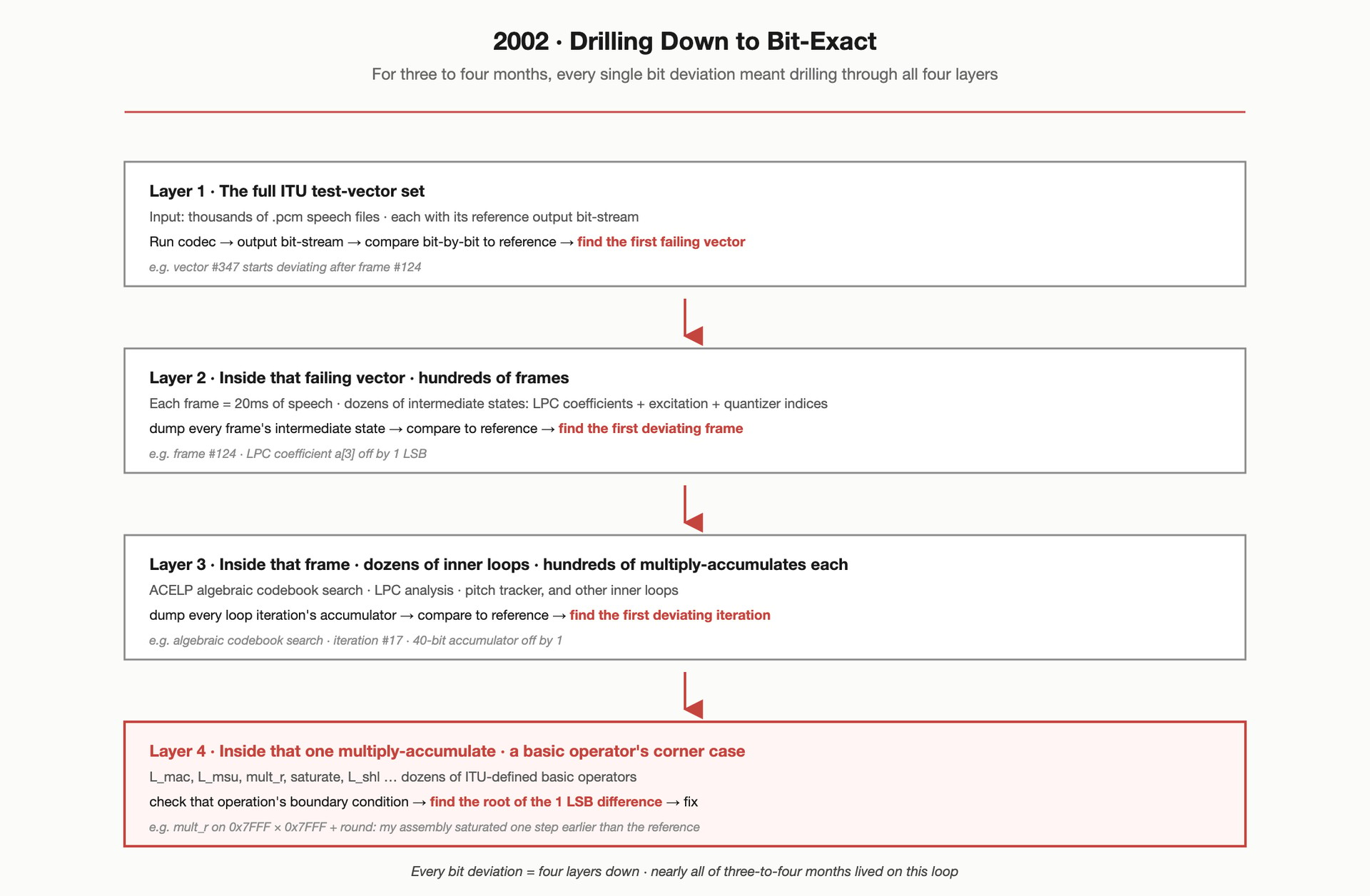
2002 · drilling down to bit-exact: every bit deviation meant drilling through four layers — from thousands of test vectors, to hundreds of frames, to dozens of inner loops, to a single basic-operator corner case worth 1 LSB.
The highest engineering aesthetic of the 20th century: bit-exact
That GSM-EFR experience wasn’t unusual. The whole second half of the 20th century built its highest engineering aesthetic around absolute determinism:
- Communication codecs: H.264, AAC, Vorbis all ship a reference implementation + test vectors; bit-exact is a precondition for certification.
- Cryptography: AES, SHA-256 — one bit off and the protocol breaks.
- Databases: the “D” in ACID is another word for deterministic.
- Formal verification: proving software correct, automatically — Coq, Lean, Z3.
- Smart contracts: the Ethereum EVM is a deterministic VM; every transaction must produce identical state on every node.
- Type systems: compile-time guarantees about runtime behavior.
- Six Sigma: 99.99966% as the quality ceiling.
Seventy years of engineering aesthetics, all the same sentence: input X always yields output Y. Test pass or test fail. Binary. No middle ground.
My GSM project was a tiny sample of that tradition — but the spirit it embodied was the whole era’s: software should be perfectly predictable.
But every other profession has always reasoned in probabilities
Step outside the software bubble for a second.
- Doctors: symptoms point to “80% flu, 15% COVID, 5% other.” No doctor ever says “it’s definitely flu, bit-exact.”
- Judges: “beyond reasonable doubt” is a ~95% threshold, not 100%.
- Investors: every decision is a distribution — expected return, Sharpe ratio, max drawdown. Never “this stock will definitely go up.”
- Weather: 70% chance of rain tomorrow.
- Evolutionary biology: random mutation + selection pressure — stochastic at its core.
- Quantum physics: the Heisenberg uncertainty principle is probability, all the way down.
Only software engineers got to enjoy absolute determinism for 70 years. Every other profession — millennia of human intellectual work — has always thought in probabilities.
The bit-exact my generation chased, seen against the longer history of engineering, is a 70-year anomaly, not the norm.
Until LLMs took the privilege away.
2026 · The same prompt, two different outputs
A staff engineer recently described to me the moment he first slammed into LLM probability.
He was building an LLM integration, and out of pure software-engineer instinct he wrote a unit test: “given prompt X, expect the output to contain string Y.”
First run, pass. Second run, fail.
He assumed something was wrong with the environment — restarted, cleared the cache, ran it five or six times — a different result every time. He opened the trace in LangSmith and stared at it for three hours.
The conclusion he reached: every unit test he’d ever written had, in essence, stopped working.
In 2002, when I was doing GSM-EFR, the same input producing two different outputs was an absolute bug — a thing that must not happen. I’d immediately go hunt for the uninitialized register, the race condition.
In 2026, the same prompt producing two different outputs is an LLM feature — not just allowed, but the temperature parameter literally tells you it will happen.
That staff engineer wasn’t being tortured by a bug. He was watching the “absolute determinism of software” he’d believed in his whole career simply disappear.
The engineer’s everyday paradigm shift
LLMs translate the entire daily toolchain of software engineering from “deterministic” into “probabilistic”:
| Old paradigm (deterministic) | New paradigm (probabilistic) |
| Unit test: input X → must output Y | Eval suite: n=1000 samples, accuracy > 95% |
| Bug fix: fixed, never recurs | Failure mode: drive the 5% failure rate down to 2% |
| Stack trace: pinpoint the exact failing line | Distribution analysis: cluster the failures, find the pattern |
| Refactor: behavior unchanged | Refactor: behavior statistically unchanged |
| Code review: is the behavior correct? | Prompt + eval review: is the distribution acceptable? |
| Type system: compile-time guarantee | Structured output: runtime validation |
| Reproducibility: fully reproducible | Statistical reproducibility: the distribution reproduces |
| "It works" / "it doesn't" | "It works 95% of the time; the failure mode is…" |
Every left-hand cell is my engineer’s instinct from doing GSM in 2002. Every right-hand cell is the reality a 2026 LLM engineer has to accept.
Determinism at the application layer is dead — but rigor isn’t. It moved.
Rigor didn’t vanish — it moved into the harness
LLMs turned product output from deterministic into probabilistic. But engineers didn’t give up the pursuit of bit-exact — the rigor didn’t disappear; it relocated one level up the abstraction.
Concretely:
- The 2002 era: the codec implementation itself had to be bit-exact, so the eval was simple enough that it needed no framework — run the ITU test vectors, compare bit-by-bit.
- The 2026 era: the LLM output itself is probabilistic, but the eval pipeline must be bit-exact.
The location of the rigor changed; the intensity didn’t. A few side-by-side comparisons:
| Old bit-exact (application layer) | New bit-exact (harness / eval layer) |
| Every sample of the codec implementation | Every record in the eval dataset |
| The reference output ITU provides | Human-labeled ground truth |
| Output bit-exact match to reference = pass | Statistical delta vs baseline < threshold = pass |
| Run the regression test every commit | Run the regression eval every prompt / model change |
| Stack trace down to the line | Trace + intermediate state down to the token |
| Test set: thousands of ITU .pcm vectors | Test set: tens of thousands of labeled records |
| Reference output never changes | Rubric + grader model + temperature all version-locked |
Your LLM output is probabilistic, but your LLM eval pipeline must be bit-exact — otherwise you simply cannot tell whether today’s experiment is better or worse than yesterday’s.
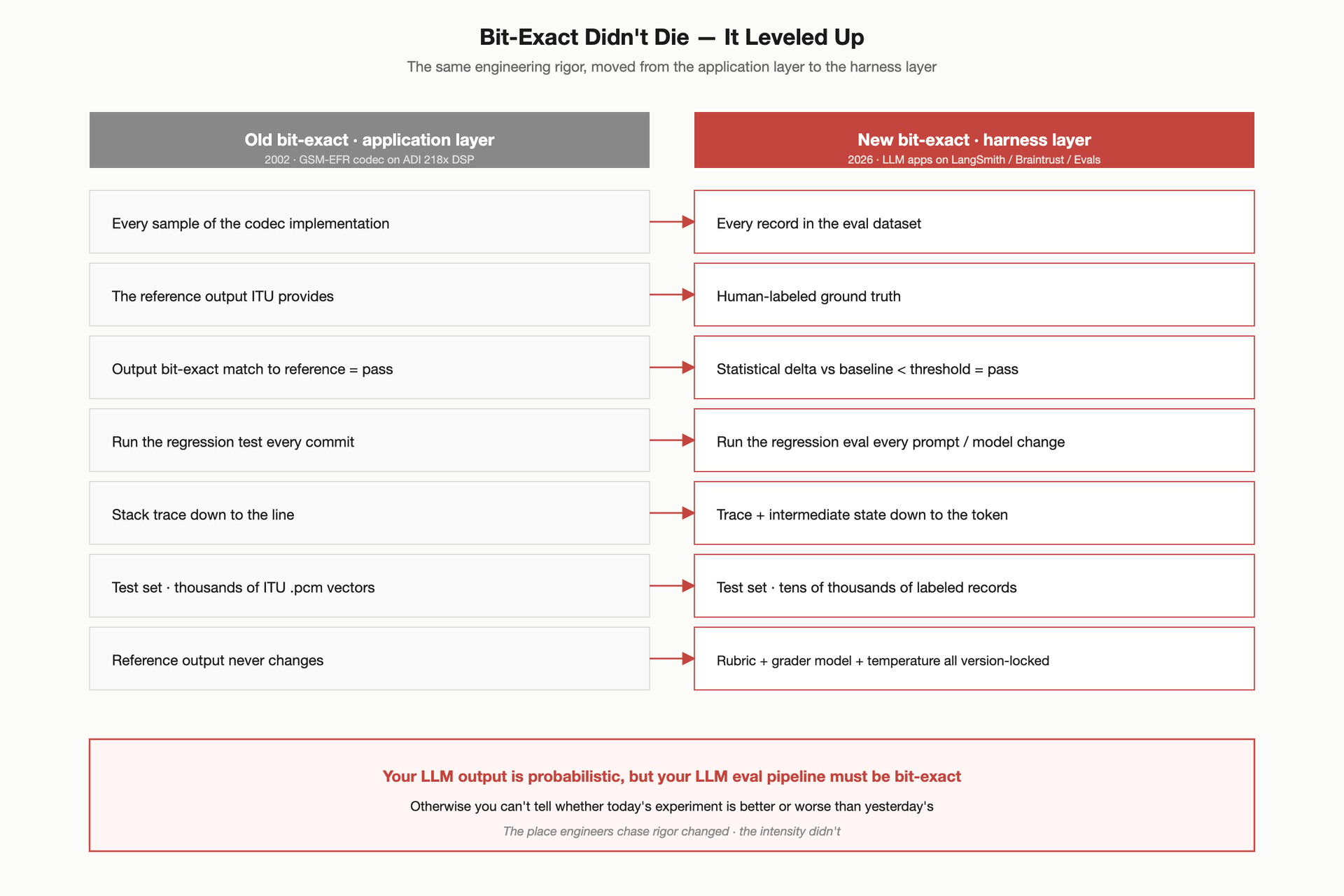
Bit-exact didn’t die — it leveled up: the same engineering rigor moved from the 2002 codec implementation (sample bit-exact) to the 2026 eval pipeline (trace bit-exact). The place changed; the intensity didn’t.
This already existed in every other “probabilistic” profession:
- A doctor can’t guarantee curing every patient, but the diagnostic protocol must be strict — the same symptoms must follow the same workflow.
- Medical research can’t guarantee a positive trial, but the RCT design must be bit-exact — randomization, blinding, controls, all reproducible.
- A judge can’t guarantee every verdict is right, but the legal procedure must be strict — same evidence, same procedure, or it’s a mistrial.
- An investor can’t guarantee every trade profits, but the backtest code, risk models, attribution must be bit-exact — same input, same backtest result.
Every “probabilistic” profession keeps one thing bit-exact: its methodology itself.
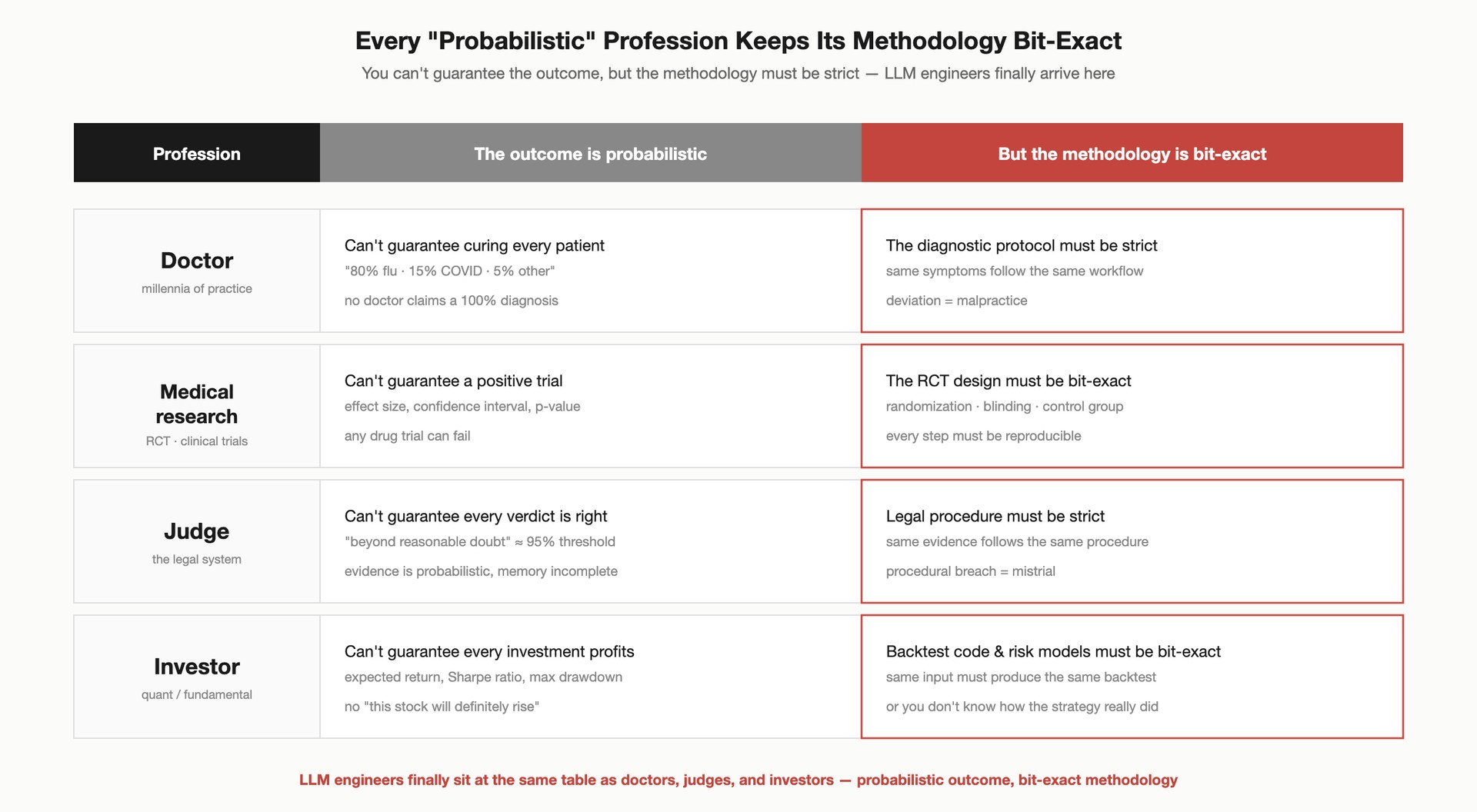
Doctors, medical research, judges, investors — the outcome is probabilistic in every column, but the methodology is bit-exact. LLM engineers have finally arrived at the same table.
LLM engineers have finally reached the same place. The bit-exact I chased on an ADI 218x in 2002 corresponds today to: on LangSmith / Braintrust / OpenAI Evals, every trace must be reproducible, every prompt version traceable, every eval comparable bit-exact to the baseline.
Bit-exact didn’t die. It leveled up.
Information theory: determinism = zero entropy = zero information
Translate this into Shannon’s language:
Information = the receiver’s degree of surprise.
A fully deterministic system can’t transmit any information. Talk to an oracle that answers “the east” every time you ask “which way will the sun rise tomorrow” — that oracle’s output has zero entropy, and zero information.
An LLM’s high entropy isn’t a bug — it’s the physical basis for its ability to tell you something you didn’t know. It’s useful to you precisely because the output is probabilistic — it can explore a high-dimensional space and surprise you.
Look back at that bit-exact GSM-EFR codec — to its receiver it has zero entropy: given the input, you can fully predict the output. That’s its function (encode/decode must be deterministic) and its limit (it can’t tell you anything outside its input).
An LLM is high-entropy, so it can “create.” GSM-EFR is zero-entropy, so it can “transmit.”
Two different things — and for 70 years we only ever saw the latter.
Where bit-exact is still alive
Physically, bit-exact didn’t die — it just went from “the default of software engineering” to “a special case that occupies one small corner”:
- Smart contracts: the Ethereum EVM must be deterministic; every transaction produces identical state on every node. One failure = consensus collapse.
- Payments / finance: transfer amounts must be bit-exact; you can’t tolerate even accumulated floating-point error.
- Cryptographic hashes: change one input bit to SHA-256 and the output changes completely — that’s the function.
- Protocol codecs: a voice codec like GSM-EFR still runs bit-exact in the baseband chip of every 4G/5G phone.
Hybrid systems are becoming the new paradigm: LLM generates → deterministic validator checks. LLM writes code → unit tests run (deterministic). LLM gives a medical suggestion → a rule engine filters out anything non-compliant.
An LLM’s high entropy makes it useful; determinism’s low entropy makes the result trustworthy. The two now have to coexist.
That assembly I wrote in 2002 — it still runs bit-exact in some chip company’s modem baseband somewhere. Every bit still matches the ITU reference.
But the world around it is no longer the same.
Engineers finally sit at the same table as doctors
The absolute determinism software engineers enjoyed for 70 years was never the norm. It was a unique anomaly in the history of engineering — every other profession (doctors, judges, investors, biologists, physicists) has always made probabilistic judgments. Only software engineers thought they’d been handed the key to “absolutely correct.”
LLMs took that key away from the application layer.
But rigor didn’t disappear; it leveled up — from every sample of a codec being bit-exact to every trace of an eval pipeline being bit-exact. Medicine, law, and finance did this long ago: you can’t guarantee the outcome, but you guarantee that your methodology is bit-exact.
LLM engineers are simply, finally, walking the same road.
This isn’t a loss. It’s a return to the way life actually is.
After leveling up, rewrite four things
Stop trusting a single unit test — build a bit-exact eval suite.
Stop chasing bit-exact application output — chase a bit-exact eval pipeline.
Stop fixing single bugs — build a bit-exact regression eval that tracks the failure-mode distribution.
Stop debugging by stack trace — build a bit-exact trace + intermediate-state system.
And most important — learn to think like a doctor, a judge, an investor: decisions rest on distributions, but the methodology must be as strict as an ITU test vector.
Accept that 95% is the reality of the work, not a 95% compromise.
🎯
That assembly from 2002 was burned into the baseband chips of hundreds of millions of phones. In that moment I believed software could achieve absolute determinism. Twenty-some years later I sit in front of LangSmith, looking at an LLM trace. The same prompt, two different outputs. I looked at it for three hours. By the end I realized — what I’m chasing now isn’t bit-exact LLM output; it’s bit-exact for every trace, every prompt version, every eval on LangSmith. Bit-exact didn’t die. It leveled up. It’s not that LLMs made things worse. The universe was always like this — we engineers just faked determinism for 70 years — and now we’re finally working the way the universe actually works.
Sean · seanslab.org · Seeing the world through information theory · 2026